Mission Muzaffarpur
The journey of establishment of a cancer hospital in one of the most underserved area.
One afternoon of July 2017, the Director of Tata Memorial Centre called me in his office to inform that there was an official request to establish a cancer hospital in Muzaffarpur, Bihar. My instant reaction was something like; you must be kidding! I had a detailed discussion on challenges of making a unit of Tata Memorial Centre in Bihar and tried to convince him that it was not a good idea. Having spent my childhood in eastern UP and having lived in Bhagalpur, I knew about the ground realities in Bihar more than anyone else in Tata Memorial Hospital. I was given the task of visiting Muzaffarpur and prepare a detailed feasibility report. In the morning of 9th August 2017, I reached Patna and headed towards Muzaffarpur. It was an unforgettable journey. We got stuck on the bridge over the river Ganga for 2 hours, some of the roads were almost invisible due to flood water flowing over it, there were no places for eating, our car broke down and we had to physically push it in the pouring rain to the side of the road waiting for a mechanic to arrive. Drenched and tired, I reached the Medical College Hospital guest house by 7 pm when it was already pitch dark. I was welcomed by an old man holding torch light in his hand because there was an electricity failure. My room had a candle, but it could not be lit due to wind coming from the broken windows. Following a candle light dinner, I decided to go to bed early. In the absence of a fan and inability to close the windows, my next challenge was to adjust with hundreds of mosquitoes. Sleepless and exhausted, I was getting clearer about the contents of my feasibility report. Next morning, I visited the medical college and met the officials and the doctors. The indoor wards were in a very bad condition, the ICU had no functioning equipment, the operation theatre was rudimentary, the OPD was smelly, the blood bank was shut down, the labs were very basic, the corridors were filthy, all open spaces of hospital were strewn with garbage, the drains were choked and overflowing. What struck me during the entire visit was the absence of doctors in the hospital. I was told that all of them have a busy private practice and most of them hardly visited the hospital. The morning visit gave me an insight into the work culture in that region. I could foresee challenges in maintaining our quality standards in such an ecosystem.
I was shown one piece of the land inside the medical college that was ear marked for the proposed cancer hospital. It was a large stretch of stinking, slushy land that seemed to be the stagnant sewage interspersed with the trees. In the afternoon, I got back to the guest house for lunch with the houseflies and cockroaches! I was fondly told by the elderly caretaker that I should use my right hand for eating and left hand for driving the flies away. When I went inside the kitchen area to wash my hand, it was quite shocking. Had I visited the kitchen before the lunch, I may have decided to fast. The return journey to Patna was equally adventurous and I could barely manage to catch my flight. It was increasingly getting clearer that setting up a tertiary care facility in such a rural and rudimentary setting is impossible. The Feasibility report that I prepared in the flight on route to Mumbai was obvious. I proposed that we could do much better in offering treatment to people of Bihar in our existing hospitals in Mumbai and Navi Mumbai. I highlighted the challenges in recruitment and retention of good staff that is essential to maintain our standards. I concluded in my report that, TMC should not consider building a hospital in Muzaffarpur.
Back to Mumbai, I had another urgent task that I was to undertake the next day. The footpaths around Tata Memorial Hospital were encroached by our patients. This happened due to very high number of patients who got free/subsidized treatment at TMH but we were not able to arrange subsidized housing for all of them. I was told to conduct a survey of the footpath dwellers and prepare a report and work towards a solution for this problem. To prepare this report I decided to visit and interact with the patients living on the footpath. The entire 2-hour tour of the footpath was an eye-opener for me. It was an agonizing moment of realization and awakening. Those patients were taking treatment at TMH braving poverty, lack of social support, lethality of disease, complexity of treatment, pathetic living conditions on footpath. There were patients who had undergone surgery and living on the footpath with flies all over them. There were very sick patients with feeding tubes, urinary rubes, drains in their body recuperating on the footpaths. There was an old man with seemingly advanced mouth cancer with bandage all around his face. As I went close to him, I could not stand the unbearable stench of dying and decaying tissues coming from his wound. His caregiver was using the bed pan for collecting his urine and faeces, putting it in a plastic packet and disposing it in a roadside garbage bin. This was just across the street of TMH, where we take pride of being the premier cancer centres in the country offering world class treatment. I witnessed a place in Mumbai that was worse than Muzaffarpur just in front of our hospital. Then I met a young lady in her early 30s with a hugely distended abdomen, breathless and visibly distressed. Despite her own weakness, she was feeding a young boy of around 3 years who was possibly her child. She was Kunti, a resident of Bihar who was diagnosed with advanced ovarian carcinoma undergoing treatment at our hospital for the last 3 months. She had only 2 caregivers with her at Mumbai, a 3-year boy and another 10-year girl. The husband came to drop her but could not stay longer due to a flood situation in their village. While I was talking to Kunti, I saw her daughter coming back with a food packet that she got by begging. Kunti had indomitable desire to live and give a bright future to her kids. She was a Hindi teacher in a primary school in Darbhanga that is 1 hour away from Muzaffarpur. She was ready to endure the trauma of living on footpath to live long enough to give proper education to her kids. Little did she know that, given her diseases status, she won’t live more than 6 months. Even if the disease was kind to her, the pitiable living conditions on the footpath would surely kill her given her low immunity following chemotherapy. What she said to me was an ultimate example of human resilience and perhaps an unforgettable lesson for me. She said in Hindi that I am translating in English – “I am lucky that I am getting treatment at Tata Hospital. There are thousands back home who are unable to reach here and die because of lack of access to treatment. Even if I die, I will die peacefully because of the satisfaction that I was treated at Tata Memorial Hospital. Rest is in the hands of God and we can’t do much. Walking back towards my office at TMH, I was a different person. I saw the truth. I understood the expectations. I witnessed the failure of our health care. The feasibility report was modified. Kunti had convinced me that we must build a hospital in Muzaffarpur.
As soon as the word spread that TMC is planning to build a cancer hospital in Muzaffarpur, I became a subject of satire, sarcasm and ridicule. Each such episode, only strengthened my resolve to go ahead with the plan. Many felt that I was being obstinate, overconfident, and unrealistic. In short, people had written an obituary of this project even before it was born. I firmly believed that the best way to silence the critics was by proving them wrong. We had to build a hospital that withstands the high standards set by TMC. We also needed to ensure that the new hospital should reflect TMC culture. Realizing that the government money sanctioned for the project was insufficient, my first challenge was to raise more funds for building a hospital that will withstand the load for at least 5 years from the date of commissioning. We were fortunate to get the support from multiple CSR sources that doubled the kitty that we had for building the hospital.
With land and funds available, my next challenge was to navigate the prescribed governmental process. Being a surgeon, I am not used to delays in planning and execution. A surgeon’s life revolves around instant decision and its immediate implementation. In administration, I learnt the art of patience - working with multiple committees and follow the multi-layered process of execution. Indeed, this is designed to ensure transparency and accountability. While the goal is right, the path was very distressing for a person like me. To continue the momentum till the hospital building was ready, we embarked on several activities with whatever was available to us. The medical college was generous to offer 3 rooms to us that was the beginning of our services at Muzaffarpur. We decided to start the population-based cancer registry (PBCR) and early detection program in September 2018. It was the first PBCR of the state that faced multiple challenges. The PBCR report brought a very glaring fact that majority of the cancers are presenting in incurable stages despite being preventable or suitable for early detection. Later, this prompted us to work with the Bihar government to launch India’s most ambitious awareness and early detection program covering all 38 districts.
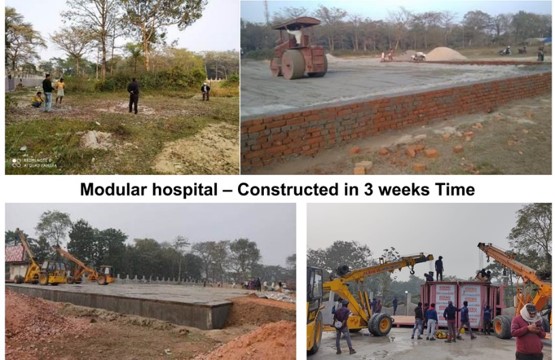
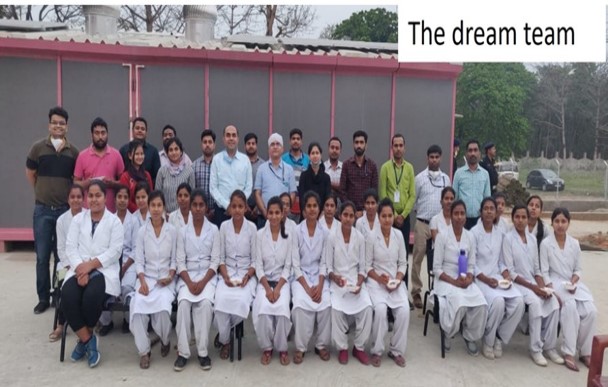
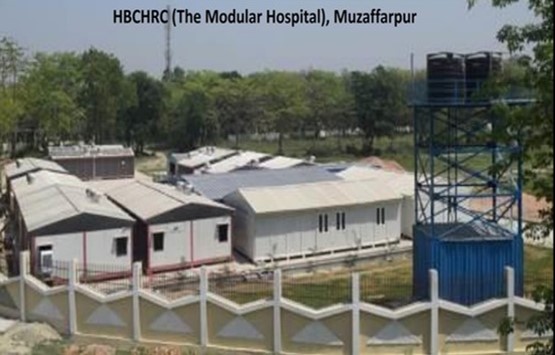
Once the message spread that Tata Memorial Centre has an office in the medical college premises, patients started coming seeking treatment or guidance. When the numbers as well as expectations grew up, we had no choice but to start the Tele Consultation with the TMH doctors. That led to further increase of footfall at our site-office. That was the time when first wave of covid stuck and hospital construction related activities came to a standstill. The travel restrictions during those days led to a further increase in the number of local patients visiting the office. The 3-room office was obviously inappropriate for patient care. Motivated by the plight of such an ever-increasing number of distressed people, we were desperately looking for more space to offer basic cancer care. We were supported by ‘Doctors for You’ with a pre-fabricated hospital that was commissioned in 3 months. On 4th February 2021, we started the facility with 5 prefabricated porta cabins. This Modular Hospital had a Waiting area, Outpatient’s clinic, Day care ward, Pharmacy, canteen and offices. With a team of motivated doctors, nurses, technicians and administrative staff we were able to deliver basic cancer care. We commissioned our biochemistry, microbiology and histopathology labs in spaces borrowed from the medical college. We utilized the existing outsourcing services of the medical colleges for CT- Scan and MRI of our patients. The workload can be gauged from the fact that in that particular year, we registered 2000 new cancer patients. I frequently faced skeptics who didn’t lose any opportunity to criticise that the hospital was diluting the TMC standards. The critics were confident that the project is bound to fail because of its glaring shortcomings. Someone once said, will you send your own relative for treatment at Muzaffarpur? I said, the hospital is not meant for those who have options to choose from. Our hospital was for those who have to chose between some treatment or no treatment.
While delivery of chemotherapy was possible in the make-shift Modular Hospital, patients were disappointed when they realised that we did not offer Surgery or Radiotherapy. We then took an audacious decision to start surgery services in Muzaffarpur. We renovated an unused OT in the Trauma Centre of the medical college and started performing surgeries despite challenges of non-availability of anaesthetist, intensivist, qualified senior residents, trained nurses, blood bank, sterilization services and surgical consumables. I performed first surgery on a rickshaw puller with advanced mouth cancer. Once we started the surgical service, all the support services got systematically and steadily strengthened that led to overall improvement in the delivery of care. Sceptics couldn’t believe that surgeries were possible in a place like Muzaffarpur. While the 6 OTs of the medical college remained largely unused, the one OT utilized by us performed 300 major surgeries that particular year. This led to churning and brainstorming within the medical college with resultant improvement in discipline and delivery of care in their hospital. Our hospital was now transforming the culture of the adjoining medical college.
The footfall of the hospital kept increasing and in 2022, we registered nearly 5000 patients. The hospital was far from complete and we were in dire need for more beds for day care as well as indoor admissions. The shortage of beds was leading to patient discomfort and dilution of TMC standards too. Somewhere, the desire to silence the critics continued to play in my mind. By that time, the COVID pandemic was over and an isolation facility with 100 beds was lying unused. The State government agreed to handover the pre-fabricated isolation facility to us. Through this, we were now able to give a full range of services, (except Radiotherapy) to our patients. To overcome this shortcoming, we coordinated with the government hospitals in Patna and ensured that our patients got timely radiotherapy. While our hospital offered laboratory, surgery and chemotherapy services to them, medical colleges of Patna gave timely radiotherapy to our patients. What could be done to silence the critics next? Realizing the lack of paediatric oncology facility in our hospital, we aimed to start it but space, supportive services and manpower was the challenge. Muzaffarpur magic and TMC culture worked again. We requested the medical college to give us a part of the paediatric ward in their paediatric hospital. This dedicated paediatric hospital was built in Muzaffarpur to take care of the outbreaks of encephalitis in children during the summer. Fortunately, those outbreaks had diminished and the occupancy of the wards was low. With the availability of the paediatric ward, we made the modest beginning of Bihar’s first paediatric oncology facility. The sweetest triumph is not in proving yourself right, but in turning the doubters into your followers.
While my colleagues were attending international meetings, I was monitoring the progress of construction work at Muzaffarpur. I preferred spending time with laborers in chilling summer rather than go on vacation with my family. It was agonizing to remain away from OT and OPD for several weeks. Those 2-3 years, I hardly published any scientific paper. I was deeply involved in commissioning of 2 hospitals in Varanasi while construction of hospital in Muzaffarpur was also going on. There is a famous saying, you don’t feel tired when you love the work you are doing. I enjoyed being the fulcrum of transformation.
One day, when I was visiting Muzaffarpur for project monitoring in December 2023, a lady walked into my office with a teenage daughter. She looked familiar. I had tears in my eyes when she identified herself as Kunti. She was startled when I touched her feat. Kunti was the prime motivator for the Mission Muzaffarpur.
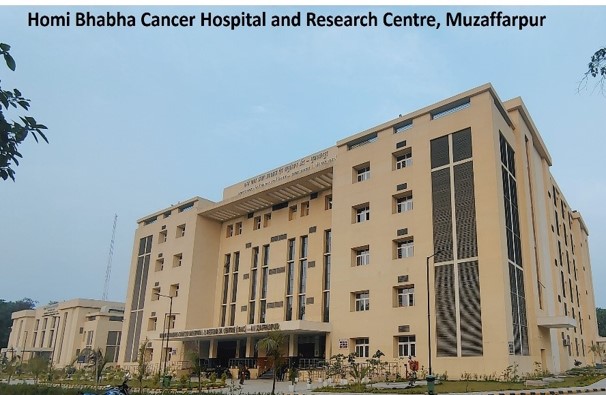
Fast forward to 22nd August 2025, the Prime Minister dedicated the Homi Bhabha cancer Hospital and Research Centre (HBCHRC) to the nation, it was the culmination of hard work of hundreds of people who worked in most challenging circumstances to save lives of their countrymen. The hospital has now added 3 linear accelerators treating 250 patients every day and given 26000 sessions of Radiotherapy till date. In the year 2025, the hospital registered 8034 patients. From 2021 to 2025, the hospital has treated 26,000 new patients, given 75254 sessions of chemotherapy, conducted 14722 surgeries and performed 1.6 million laboratory procedures. The Mission Muzaffarpur demonstrates how institutional vision, government backing, CSR support and professional dedication, can do miracles in an underserved region. It is not about building a temple of healing, but a symbol of perseverance, courage and compassion that will shine for generations.
Acknowledgement – There are numerous people who have contributed immensely in this extraordinary journey. Contribution of each one is equally important. That is why I have not mentioned any names in this entire write up.
Dr. Pankaj Chaturvedi
Director, ACTREC