

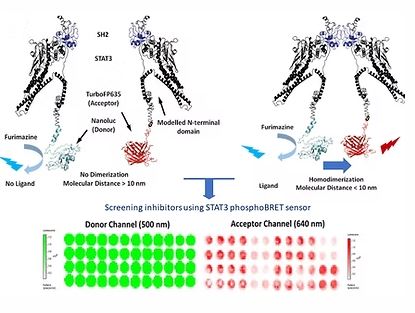
Cancer cell signaling is a vast area of research, where protein-protein interactions, protein activation and degradation kinetics play vital roles in cellular signaling. We have been rigorously developing and using bioluminescence resonance energy transfer (BRET) based assessment method to study cell signaling and protein-protein interactions. We are pursuing the design of various BRET reporter sensors for important cancer-targeting proteins intimately involved in oncogenic signaling. In recent years, our lab has designed multiple BRET sensors for determining protein activation in vivo. These sensors detect intracellular STAT3, AKT and ERK activation status directly from live cancer cells. Using phospho-STAT3 BRET sensor, we have identified few drug molecules with STAT3 inhibitory function [Experimental Cell Research 396 (2020) 112313; Experimental Cell Research 396 (2020) 112313]. Our work analyzing patient tumor tissue samples revealed the importance of phospho-serine post-translational modification as a measure of STAT3 activation in triple negative breast cancer (TNBC) subtype. Therefore, we further aim to develop spectrally separable multiplexed BRET-PTM sensor to study the underneath cancer biology in breast cancer cells, where downstream functional response is regulated by either canonical or non-canonical phosphoSTAT3 marks in different subtypes. For the AKT and the ERK sensors, work done in collaboration with Dr. Pritha Ray's laboratory at ACTREC, use of BRET based sensing was demonstrated for the first time in platinum drug resistant patient's derived ovarian cancer cells [Translational Oncology 14 (2021) 101193].